
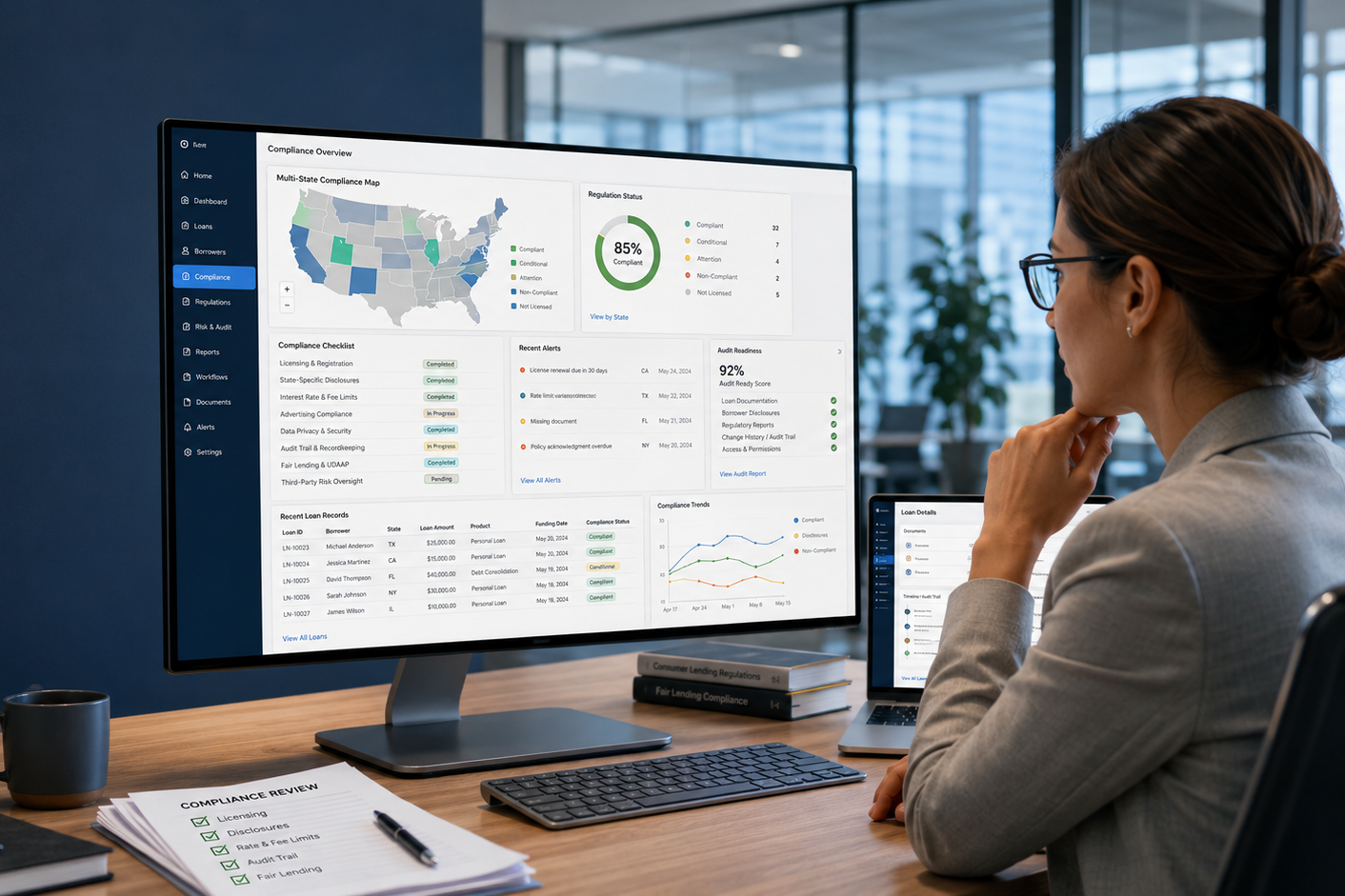
Multi-State Lending Compliance Software for Modern Lenders
When lenders cross state lines, the rules for how they operate instantly become far more complicated than they already were. Operating nationwide means being subject to more than 50 unique licensing regimes, usury rules, disclosure requirements, and exam cycles. This is in addition to the tangle of existing federal frameworks such as TILA, RESPA, ECOA, FCRA, and BSA/AML.
Making matters more difficult for lenders is the fact that enforcement is no longer limited to the federal level. According to the CFPB, 2023 alone saw lawbreaking lenders subjected to 29 enforcement actions totaling more than $3 billion in consumer redress and $498 million in civil penalties. At the same time, state DFIs and AGs are issuing their own consent orders for disclosure, fee-cap, and licensing breaches.
Although manual compliance can scale with branch and product count, it fares less successfully when regulatory complexity increases. This means purpose-built technology is the only sustainable way to close the gap. This is especially true for multi-state lenders with more than 75 locations. These lenders know that configurable, rules-based platforms aren’t just nice to have — they’re an operational necessity.
What Multi-State Lending Compliance Software Actually Means
Lending compliance software built for multi-state lenders combines configurable rules engines, jurisdiction-specific disclosures, automated reporting, license tracking, and audit trails inside a single system that ties directly to origination and servicing data. It replaces the patchwork collection of LOS plugins, document templates, spreadsheets, and outsourced legal reviews that legacy lenders often rely on for their work.
These platforms tend to be best suited for multi-state retail networks with more than 75 branches and high-volume online lenders. Smaller single-state lenders typically can defer. Vergent LMS is a configurable end-to-end platform that combines loan origination, loan servicing, and compliance controls into a single audit-ready system backed by SOC 1 Type II and SOC 2 Type II attestations.
The Federal Compliance Layer Every Multi-State Lender Must Cover
Meeting federal compliance frameworks such as TILA, RESPA, ECOA, FCRA, FDCPA, GLBA, BSA/AML, MLA, and SCRA is the baseline expectation. State-level requirements provide added layers of complexity on top of this. Retail and small-business lenders devote a considerable amount of compliance bandwidth toward HMDA and CRA reporting, and ECOA fair lending analysis is now an examiner expectation. Vergent supports lenders with the federal layer through its configurable workflows, automated audit trails, and integrations with credit bureaus such as Experian and Equifax as well as verification services like Plaid.
The State Compliance Layer Where Most Multi-State Lenders Actually Bleed
State-level compliance can vary a lot because of licensing requirements, maximum APRs and fee caps, mandatory disclosures, cooling-off periods, repossession and collection rules, and product-specific rules focused on payday, title, installment, and other loan types. In particular, NMLS license management stands as its own discipline in many ways, with branch licenses, MLO licenses, surety bonds, renewal cycles, and state call reports must all stay current to avoid involuntary inactivation.
Online lenders face even more complexity, with state laws concerning borrowers in one state working with lenders based in another still hotly contested to this day. This is where having a configurable rules engine that can hold each state’s APR ceiling, disclosure variant, and document template inline with origination so valuable. More than a glorified LOS, Vergent’s workflow engine and Decision Engine are designed for this exact type of jurisdictional overlap.
Core Capabilities to Demand from a Multi-State Compliance Platform
Lenders who want to leverage a compliance management software platform for multiple states should consider certain features to be non-negotiable, including:
- Configurable rules engine with full audit trail
- Jurisdiction-aware document generation
- Automated HMDA/CRA/1071 reporting
- Fair lending analytics
- License tracking
- Exam-ready report packages
These capabilities should run inside the loan lifecycle, not just alongside it. Reporting also should not require lenders to rebuild their data pipelines. Vergent ships with more than 80 integrations including credit bureaus, identity/income verification, payment rails, analytics, and open APIs for proprietary risk models.
Where Compliance Programs Quietly Break and How Software Catches It
Some of the most common errors in multi-state compliance programs that go unnoticed by lenders include outdated disclosure templates following a state rule change, fee miscalculations in edge-case product configurations, geocoding errors in HMDA/CRA submissions, expired branch or MLO licenses, and gaps in adverse action notices. Automated rules-based controls block non-compliant loans pre-origination, rather than catching them in post-funding OC, which creates a fundamentally different risk posture for lenders.
According to McKinsey, lenders who overhaul their operations based on straight-through processing can significantly reduce errors. Automation can be the key to closing those gaps.
The ROI Case: From Compliance Cost Center to Growth Enabler
A configurable compliance platform can reduce review cycle times by up to 60% through agentic AI, according to McKinsey. Automating regulatory compliance enables a lender’s ability to expand at speed, reducing the effort it takes to enter a new state from a massive project to a relatively simple configuration exercise. For lenders with more than 75 locations or significant online volume, the ROI of utilizing a compliance platform typically pays for itself within the first full exam cycle.
How to Evaluate and Buy a Multi-State Compliance Platform
Here are some of the most important features to look for when purchasing a multi-state compliance platform:
- Configurable rules per jurisdiction
- Document automation depth
- Named LOS/core integrations
- SOC 1/2/3 attestations
- Dedicated implementation support
- 24/7 customer service
Lenders should ask how long adding a state typically takes under the system, as well as how regulatory changes are pushed to live loans in flight. Other questions to ask include who owns regulatory content updates and what the audit trail granularity is per loan.
Vergent’s end-to-end model consolidates compliance with origination and servicing in a single platform. This eliminates reconciliation between systems and gives examiners a single source of truth. Built with more than 160 years of combined lending experience and a seven-time Inc. 5000 honoree, Vergent offers a full-featured solution. Get in touch with us today to learn more.
Multi-State Lending Compliance: Key Considerations by Jurisdiction
- State licensing requirements, Most states require non-bank consumer lenders to hold a state lending license. Some states (California, New York, Illinois, Texas) have stringent licensing requirements with detailed application processes and ongoing reporting obligations. Operating without a required license exposes lenders to civil penalties and potential criminal liability.
- Usury and rate caps, Maximum interest rates vary significantly by state and loan type. Some states (like Texas) allow relatively high APRs for consumer installment loans; others (like Colorado, since the 2018 CFPB rule adoption) cap rates more aggressively. Know your per-state rate caps before originating in any new state.
- Required disclosures, Beyond federal TILA disclosures, many states require additional borrower disclosures, state-specific APR notices, prepayment penalty disclosures, or required language in collection communications. These must be generated correctly for every loan originated in that state.
- Collections law variations, While Regulation F establishes federal floors for collections practices, states can (and do) impose stricter requirements. California’s Rosenthal Act, New York’s DCWP rules, and similar state laws require additional consumer protections beyond FDCPA/Reg F minimums.
- BNPL regulations, California, New York, and Colorado have enacted or proposed specific regulatory frameworks for Buy Now Pay Later products that may not apply in other states. Multi-state BNPL lenders must monitor state-level BNPL regulatory activity closely.
Frequently Asked Questions
What is multi-state lending compliance?
Multi-state lending compliance is the practice of ensuring that every loan originated in a given state meets that state’s specific regulatory requirements, including state-mandated disclosures, applicable interest rate caps, required license filings, and state-specific collections rules, on top of the federal regulatory framework that applies in all states. For lenders operating across many states, multi-state compliance management is a significant operational challenge because state requirements vary substantially and change regularly as state legislatures update consumer lending laws.
By the numbers: The consumer loan delinquency rate at commercial banks reached 2.62% in Q4 2025, with credit cards at 2.94%, according to Federal Reserve charge-off and delinquency data. Against $5.1 trillion in total consumer credit outstanding per the Federal Reserve G.19 report, even small improvements in risk detection translate to significant portfolio impact.
How many states require a non-bank lender license?
The majority of U.S. states require non-bank consumer lenders to hold a state-issued lending license before originating loans to residents of that state. The specific license type, application requirements, and ongoing reporting obligations vary by state. Some states (California, New York, New Jersey, Illinois) have comprehensive lending licensing regimes with detailed annual reporting requirements. A handful of states with state-chartered bank structures allow federal preemption for certain loan products. Lenders expanding into new states should conduct state-specific licensing due diligence with qualified regulatory counsel before originating any loans in that jurisdiction.
How does lending software help with multi-state compliance?
Modern lending platforms like Vergent LMS address multi-state compliance by allowing jurisdiction-specific rule configuration: different disclosure templates for different states, state-specific rate cap enforcement that prevents originating loans above the applicable limit, state-appropriate collections communication rules, and state-specific data extraction for annual license report filings. When a state updates its lending laws, the platform configuration is updated for that jurisdiction, applying the new requirements automatically to loans originated in that state without affecting originations in other states where the rules haven’t changed.
What happens if a lender originates loans without the required state license?
Originating consumer loans without a required state license can result in serious consequences: civil penalties, required refund of all interest and fees collected from affected borrowers (making the loans void in some states), loss of the ability to collect on existing loans originated without a license, regulatory prohibition from future lending activities in that state, and in some cases criminal liability for officers. State attorneys general and state banking regulators actively enforce licensing requirements. Non-bank lenders expanding into new states should assume a license is required and verify with regulatory counsel before originating, not after.
Related Reading
- What Makes Great Loan Management Software?, The 12-feature checklist every lender should use to evaluate platforms.
- What Is a Loan Management System?, Full guide to LMS features, benefits, and what to look for.
- Loan Origination Best Practices for Lenders, Actionable best practices for faster approvals and lower risk.
